Showing posts with label Vegetables. Show all posts

Thursday, 19 June 2014

Golden Vegetable Paella


Ingredients:
A pinch of saffron strands
750ml hot vegetable or chicken stock
90ml olive oil
2 large onions, sliced
3 cloves garlic, chopped
275g long grain rice
50g wild rice
175g pumpkin, chopped
1 large carrot, cut into matchstick strips
1 yellow sweet pepper, sliced
4 tomatoes, peeled, seeded and chopped
115g oyster mushrooms, quartered
Sea salt and freshly ground black pepper
Strips of red, yellow and green sweet pepper to garnish

Method:
Place the saffron in a bowl with 60ml hot stock. Leave to stand for 5 minutes.

Meanwhile, heat the oil in a paella pan or large, heavy-based frying pan. Add the onions and garlic and fry over a low heat, stirring occasionally, for 3 minutes, until just beginning to soften.

Add the long grain and wild rice to the pan and toss for 2-3 minutes until coated in the oil. Add the stock to the pan, together with the pumpkin and the saffron strands and liquid. Stir the mixture as it comes to the boil, then reduce the heat to the lowest setting. Cover and cook very gently for 15 minutes without lifting the lid.

Add the carrot strips, yellow pepper, chopped tomatoes and seasoning. Replace the lid and cook very gently for a further 5 minutes, or until the rice is almost tender.

Add the mushrooms, check seasoning and cook, uncovered, for just enough time to soften the mushrooms without letting the paella stick to the pan. Garnish with the peppers and serve.


Serves 4

Sunday, 15 June 2014

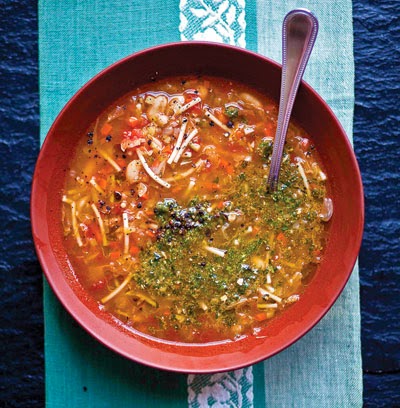
French Provencal Vegetable Soup


Pistou, the Provençal cousin of pesto, is stirred into this summer vegetable soup just before serving. To make this recipe vegetarian: omit the pancetta and substitute vegetable stock for the chicken stock. 

Ingredients:

For the Pistou:
4 cups packed basil
250ml grated parmesan
60ml extra-virgin olive oil
5ml sea salt
2 cloves garlic, chopped
1 plum tomato, cored

For the Soup:
60ml extra-virgin olive oil
30g pancetta, minced
5 cloves garlic, finely chopped
3 medium carrots, peeled and finely chopped
2 ribs celery, finely chopped
1 yellow onion, finely chopped
½ medium courgette, chopped
¼ head Savoy cabbage, cored and thinly shredded
2L chicken stock
7 whole, peeled canned tomatoes, chopped
80ml broken dried spaghetti
1 410g can cannelini beans
Kosher salt and freshly ground black pepper, to taste

Method:
Make the pistou:
Process basil, parmesan, oil, salt, garlic, and tomato in a food processor until finely ground. Season with salt and pepper, and set aside.

Heat oil in a large saucepan over medium-high heat; add pancetta and cook, stirring often, until fat has rendered, about 2 minutes. Add garlic, carrots, celery, and onions, reduce heat to medium; cook, covered and stirring occasionally, until crisp-tender, 12–15 minutes.

Add courgette and cabbage; cook, covered, until wilted, 3–5 minutes. Add stock and tomatoes, and bring to a boil. Add pasta and cook until al dente, about 8 minutes.

Purée half the beans with a blender; add to soup along with whole beans and cook until warmed through. Season with salt and pepper.

Ladle soup into bowls; serve with pistou dolloped on top.


Monday, 19 May 2014

Hearty Vegetable Stew


Ingredients:
15ml sunflower oil
2 onions, sliced
7.5ml chopped garlic
250ml carrots cut into 1cm thick slices
250ml celery cut into 2cm thick slices
500g mushrooms, cut into quarters
3 medium potatoes, unpeeled, washed and cut into 2.5cm chunks
1 x 410g can chopped tomatoes, undrained
1 x 400g can red kidney beans, drained
200ml canned tomato purée
250ml water
5ml dried thyme
1 bay leaf
Sea salt and freshly ground black pepper
 45ml flour
60ml water
60ml red wine

Method:
Heat the oil in a large, heavy saucepan over medium heat. Add the onions, garlic, carrots, celery and mushrooms. Cook for 10 minutes, stirring frequently, if necessary, adding small amounts of water to prevent sticking.

Add the remaining ingredients, except the flour, water and wine. Cover and reduce heat to low. Simmer for 30 minutes, or until the vegetables are tender. Stir occasionally while cooking.

In a small bowl, stir the water into the flour, adding the water gradually until a smooth paste is formed. Add to the stew, along with the wine, stirring well into the vegetable mix. Cook for a further 5 minutes, stirring gently. Remove and discard the bay leaf before serving.

Thursday, 8 May 2014

Chicken and Vegetable Couscous Salad


Ingredients:
Salad:
375ml water
15ml olive oil, divided
5ml salt
250ml uncooked couscous
250ml chopped yellow bell pepper
125ml finely chopped courgettes
125ml chopped mushrooms
375ml chopped skinless, boneless rotisserie chicken
125ml (1/8-inch-thick) diagonally cut carrot
60ml thinly sliced green onions
50ml dried currants
50ml finely chopped fresh mint
Freshly ground black pepper

Dressing:
250ml plain low-fat yogurt
50ml fresh lemon juice
15ml honey
15ml white wine vinegar

Method:

To prepare salad, bring water, 5ml oil, and salt to a boil in a medium saucepan; gradually stir in couscous. Remove from heat; cover and let stand 5 minutes. Fluff with a fork. Place in a large bowl; cool to room temperature.

Heat a large nonstick skillet over medium-high heat. Add remaining oil to pan. Add the bell pepper, courgettes, and mushrooms; sauté 4 minutes or until bell pepper is tender. Add bell pepper mixture, chicken, carrot, onions, currants, mint, and black pepper to couscous; toss gently to combine.

To prepare dressing, combine yogurt and remaining ingredients, stirring with a whisk. Drizzle over couscous mixture, tossing gently to combine.

Wednesday, 26 February 2014

Bacon Broccoli Cheddar Corn Muffins


Bacon Broccoli Cheddar Corn Muffins


Ingredients:
1 cup fresh or frozen chopped broccoli
About 6 baby carrots or 1 large carrot
1 cup yellow corn meal
1/2 cup all purpose flour
1/2 cup white whole wheat flour
4 teaspoons baking powder
1/2 teaspoon salt
1 Tablespoon sugar
2 strips of lean bacon
1 cup milk
1 egg
2 Tablespoons olive oil
1 loose cup of shredded Cheddar Cheese
About 2 tablespoons snipped spring onion tops


Method:
Preheat the oven to 220C.

Put the broccoli and carrot in a food processor or handi chopper and pulse to chop into little bits.

In a medium mixing bowl, add the corn meal, flours, baking powder, salt & sugar. Stir to mix well.

Meanwhile fry the bacon until crisp and chop or crumble into little bits.

Add the crumbled bacon, milk, egg, olive oil, chopped vegetables, cheese and snipped spring onion to the batter and stir just until everything is mixed well.

Spoon the batter into 12 prepared muffin tins. 

Bake at 
220C for 15 - 18 minutes or until they are golden brown on top.

Monday, 24 February 2014

Belgian Chicken Stew

Belgian Chicken Stew

Ingredients:
4 skinless chicken breasts
500ml boiling water
1 chicken stock cube
600g small new potatoes
65g butter
30ml water
2 large carrots, peeled and grated
2 large leeks, trimmed and shredded
40g flour
100ml double cream
Parsley, chopped to garnish

Method:
Poach the chicken breasts for 15 minutes in a large covered pan, with 500ml boiling water and the stock cube. Turn the chicken breasts over halfway through cooking. Meanwhile, boil the potatoes in a separate pan for 15-20 minutes or until tender. Drain and keep warm.

Melt 25g butter in a saucepan, add the carrots and leeks, plus 30ml water, cover and cook gently for 5 minutes.

Transfer the chicken breasts to a plate, cover and keep warm. Decant the stock into a jug. Melt 40g butter in the same pan you have cooked the chicken in and stir in the flour. Gradually add the stock, stirring until smooth, followed by the cream. Simmer for 3 minutes.

To serve, divide the vegetables between 4 serving plates or bowls, and place a chicken breast on top. Pour the sauce over the chicken and veg and garnish with chopped parsley.


Smoky Chicken Hotpot

Smoky Chicken Hotpot

Ingredients:
2 skinless chicken breasts, chopped
4 rashers rindless streaky bacon, each cut into 3 pieces
15ml olive oil
100g chorizo sausage, sliced into thick rings
1 onion, peeled and sliced
1 red pepper, deseeded and cut into strips
400g tin chopped tomatoes
300ml hot chicken stock
15ml dark brown sugar
410g tin chickpeas, rinsed and drained
60ml fresh chopped parsley
Salt and freshly ground black pepper

Method:
Heat a flameproof casserole dish, add the bacon and dry-fry for a few minutes. When the bacon begins to sizzle, add the oil, chicken and chorizo. Cook, stirring occasionaly, until the chicken is sealed and the pimento oil is drawn from the chorizo.

Add the onion and red pepper, put the lid on the pan and cook over medium heat for 5 minutes.

Add the tomatoes, stock, sugar, chickpeas and half of the parsley. Cover and simmer for 10 minutes, then take the lid off and simmer for another 15-20 minutes to let the sauce thicken. Season to taste.

Serve immediately, sprinled with the rest of the parsley.


Chicken and Mixed Vegetable Frittata


Ingredients:
350g skinless, cooked chicken, cut into cubes
Olive oil
1 onion, peeled and sliced,
1 garlic clove, peeled and crushed
175g frozen mixed vegetables
4 eggs
Small bunch parsley, chopped, plus extra for garnish
5ml paprika
Sea salt
Cucumber and tomato salsa

Method:
Heat a little olive oil in a non-stick 20cm frying pan.
Add the onion and garlic and cook for 1-2minutes, stirring continually. Stir in the chicken and vegetables and cook for a further 3-4 minutes.

Whisk the eggs with the chopped parsley, paprika and salt. Pour the mixture into the pan with the chicken and vegetables and cook for 6-8 minutes, or until the underneath is almost set.

Place under a preheated grill for 1-2 minutes or until the top has set. Serve in wedges,garnished with parsley, with a salad on the side.


Tuesday, 17 September 2013

Pineapple Chicken Kebabs


These are great done on the braai, 
or if cooking inside, 
in a cast iron ridged skillet pan.

Kebab Ingredients:
3-4 boneless, skinless chicken breasts
250-500g bacon
1 can of pineapple chunks
Vegetables (mushrooms, onions and peppers or others you may wish to use)
*Note: The amount of bacon and pineapple is not clearly defined in the ingredients because it just depends on how much you want to use. Alternate this way: chicken wrapped in bacon, pineapple, chicken, pineapple, chicken wrapped in bacon, etc.
Marinade Ingredients:
50ml. coconut aminos (or soysauce if these are not available)
50ml apple cider vinegar
30ml. raw honey
30ml. olive oil
1 garlic clove, crushed
Method:
Cut chicken into 1 inch cubes.
Combine coconut aminos, apple cider vinegar, honey, oil and garlic in a small bowl and blend well.
Put chicken (and vegetables, if marinating) into dish and pour marinade over top of the chicken. Stir to coat. Cover and refrigerate for at least 1 hour.
Cut bacon strips in half so you have shorter lengths to work with.
Wrap chicken chunks in bacon and put skewer through both bacon and chicken so bacon is secure. Alternate with pineapple chunks and veggies, as desired.
Braai or grill for 10 minutes. Use tongs to turn kebabs over and cook another 10-15 minutes or until chicken juices are clear and bacon is crispy.

Monday, 17 October 2011

October Fruit and Vegetables

The days are growing shorter, autumn winds are blowing and the harvest is being brought in from the orchards and fields. October is sometimes thought of as the ugly sister of September, but the reputation is not deserved. Summer, when orchard and vine are exploding with juicy, sun filled abundance, may be passed, but the warm months have helped breed new things for autumnal abundance, some being uniquely enjoyable. This year the apple trees are especially heavy laden with succulent fruit, ready to be made into jams, preservers and beverages. Wild mushrooms are abundant and squash and pumpkins are ready early for Halloween.

Americans think of pumpkin as something you put in a pie and serve at Thanksgiving. Europeans know it primarily as a savoury ingredient. In this case, the old world and the new both have it right. Pumpkin is delicious in sweet pies, but it can be put to good use in all manner of savour dishes as well. The simplest is to cut the pumpkin into pieces, removing the seeds and strings from the central cavity and steaming or baking the pieces for serving with a little butter as a vegetable. Some care needs to be taken with cooked pumpkin as it becomes fragile when cooked because of the high water content. This may be acceptable if the flesh is to be drained of excess water and served mashed. One of the nicest ways of preparing this vegetable is to roast it in pieces at low temperature for an extended time, which cooks them and simultaneously evaporates much of the water.

Some vegetables from summer are still available, especially in the early part of the month: beans, courgettes, peppers and aubergines from Europe, and beetroot, sweetcorn, sweet potatoes, celery, carrots and marrows are available in abundance.

Root vegetables are now coming into their prime. Look for parsnips, celeriac, Swedes and turnips this month to use in soups and stews as we progress into colder weather. There should also be a good selection of onions available in October. If you like to make pickled onions, now is the time to make them.

The last, but not the least, of the vegetables to be considered for consumption in October are spinach, chard and cabbages. These seem to come into their own as the days become shorter and the nights grow colder. Red cabbage is especially good when cooked with onions, pears or quinces.

Most of the berries of summer are now gone, but other fruit make up for their depletion. The apple season is in full swing, and with them come delicious pears and damsons, perfect for preserves and puddings. Autumn is also the season for nuts, with fresh walnuts being the first to be seen. They are never better than at this time of year, before the flesh has lost its moist, delicate freshness.

Figs are another October highlight, picked from the tree when fully ripe, they offer their incomparable sweet flavour for a short time before they become too soft. They are perfect torn open and savoured raw, but are also delicious baked with honey and feta cheese.

Quinces are another top choice for October, especially for jam and jelly making. Pomegranates, coming from the Mediterranean, are also abundant now. They may be one of the hardest fruit to eat, but the succulent pits are delicious in both savoury and sweet salads.

Wednesday, 10 August 2011

Mixed Vegetable Achar


Achar is a type of pickle, which originated in Malaysia. Some achars use vinegar and oil as preservatives, but I was taught to make it with mustard oil as the preservative medium. I have seen recipes that use vegetable oil and mustard powder added, but they don’t give the genuine result of the ‘Indian Achar’ I know and love, but rather come out more like piccalilli. If you are unable to get mustard oil, which is readily available from Indian or Asian supermarkets, then use vegetable oil but add more mustard seeds.

This makes about 8 x 454g jars.

Ingredients:
1 – 1.5kg carrots
500g green beans
1 small cabbage – preferably white cabbage, not Savoy
1 small cauliflower
15ml mustard seeds
15ml cumin seeds
15ml sesame seeds
12 chillies, split lengthwise, seeds left in
15ml salt
5ml ground mace
5ml ground cloves
5ml ground cardamom
30ml tandoori spice or ground chilli powder
250ml muscovado sugar
750ml mustard oil – or vegetable oil and mustard seeds

Method:

Peel the carrots and cut them into julienne pieces. I’m lazy; I put them through the chipper plate in the food processor. It might give a bit of a choppy mess with lots of little bits, but it’s for pickle, so it doesnt need to be perfect...

Wash the beans well – I find they always have a bit of dirt on them and if you don’t wash them they can add grit to your pickle. Top and tail the beans , then cut them on a slant into ½ cm lengths – the thin slither eradicates any stringiness they might have.

Remove the outer leaves of the cabbage and cut it into quarters. Cut out the hard central core and slice up the rest of the cabbage as you would for coleslaw – again, I’m lazy and run it through the thick slicer plate in the food processor.

Break up the cauliflower into small florets, cutting the larger florets in half or quarters and discarding the thick stalks. I usually cut up some of the thinner stalks into thin slithers just to add some bulk and crunch to the achar.

Blanch all the vegetables in a large pot of boiling water for 5- 10 minutes, until they are softened. Drain the water off and allow them to dry. In Durban when I made this I would lay the vegetables out on a large sheet in the sun, but we don’t have the space or get that kind of sunshine in the UK, so here I put the vegetables on baking trays and dry them for about 30 minutes in a low oven, about 150C. Once the vegetables are suitably dried – they only need to have some of the moisture taken out so they are not wet – put them into a large pickling basin.

Now you need to sterilise your jars. I usually do this by first soaking and washing the jars well in warm soapy water to remove any dirt they may have left from their previous use and to remove any labels. Once they are clean, I rinse them in warm water and place them on a baking or roasting tray. Into each jar, I pout about 1 inch of water and then put them in the oven at about 120-150C for a half an hour. If your jars have metal caps, the best way to sterilise these is to put them in a pot of water on the stove and boil them for about 10 minutes. Leave your jars in the oven and the caps in boiling water until needed.

When your jars are almost ready in the oven, make the tempering to go on the vegetables. Put the mustard seeds, cumin seeds, sesame seeds and chillies in a frying pan with about 100ml mustard oil and bring them up to heat until the cumin seeds are spitting and the mustard seeds are jumping. Pour this tempering over the vegetables in the bowl and mix through.

Mix the salt, ground mace, ground cloves, ground cardamom, tandoori spice or ground chilli powder and sugar in a bowl and add to the vegetables, blending the spices through the mixture. Now you can spoon the vegetables into prepared sterilised jars.

Lightly heat the mustard oil – or vegetable oil and mustard seeds if you prefer – in a saucepan. As soon as the oil begins to smoke, remove it from the heat and allow it to cool slightly for 4-5 minutes. Pour the oil into the jars over the vegetables until the vegetables are covered – this may take a couple of top ups in each jar as the oil makes its way through the vegetables and settles in the jars. Once all the jars are filled, you can seal the jars with their lids. Store at room temperature for about 2 weeks before using. This pickle should keep for at least 6 months or more.

Tuesday, 5 July 2011

July Fruit and Vegetables

Summer is now well entrenched and, as far as fruit and vegetables are concerned, we are in our seventh heaven; Nature truly spoils us this month with a luscious array of colourful produce. Whole ranges of tomatoes, courgettes, sweetcorn and other quintessential summer vegetables are available in copious quantities.

July sees a glut of tomatoes, which although they are not one of the UK's great crops as we don't get enough sun for them under normal conditions, those grown under' plastic' give the Mediterranean tomatoes a run for their money while the weather is good. All sorts of tomatoes are available: the beef tomato, which is great for salads and cooking, cherry tomatoes, wonderful in salads and pastas, and plum tomatoes, too tough for eating raw, but with solid flesh and good flavour that make them perfect for curries and sauces are the best to look for.

Summer is also salad season, and July is one of the peak months for salad ingredients: lettuces, cucumbers and spring onions as well as the ubiquitous tomato. To complete any salad, a dressing made with the new season garlic, which should now be available from France and Italy, puts the finishing touch.

The two other vegetable stars of July are sweetcorn and peas, a couple of vegetables that are not worth buying fresh any time other than now. I can't think of any vegetable more delicious than peas straight out of the pod or a mealie cob picked from the maize field, boiled and served with butter soon after picking! Both of these vegetables, when picked, are packed full of sugar that can make them additively sweet. But that sugar doesn't last very long. These vegetables continue to act as if they were still 'alive' after picking, using their sugar as food or converting it into starch. Sugar loss can be as high as 40% in 6 hours, which leads to a drastic drop in sweetness. The solution is to buy directly from a farm where they are picked daily, or even more frequently, or to pick them yourself and cook them immediately, where possible. If you can't cook them on the same day as picking, refrigeration storage will slow the rate of sugar loss.

Summer fruits are at their best in July, with mountains of berries and stone fruits just begging to be used. With the wonderful weather to begin the month, the English strawberries are ripening under the warm sunshine and the first raspberries are appearing with their succulent combination of acidity and sweetness. This is the time to use these berry fruits, for jam-making, baking, fruit salads or just enjoying them one berry at a time straight from the bush if you should be so lucky. July is probably the best month for making jams and preserves. The cheapest way to buy, which is important for jam makers, is by going to a 'Pick Your Own Farm', or if you don't have one in your area, is to find a farmer's market, where the quality will be good and the prices reasonable.

Cherries, peaches and nectarines should also be making a good showing this month, but choose these fruit carefully as they are picked while under-ripe to help them withstand the long journey they make to grace the shelves of our stores. sometimes they don't ripen; a trick to get them to ripen is to store them in the fridge in a paper bag. Some supermarkets sell ripe-picked stone fruit at a premium price; they may deserve the premium, but sometimes not. Less than perfect fruit can be used for puddings and preserves.

Of the fruit that is available in July, apart from our own previously mentioned berries and stone-fruit, much of the best fruit comes from more southerly climes. Melons are in good supply, succulent and sweet, making them suitable for fruit salads and for serving with cold meats, hams and spicy sausages.

A fruit that is available most of the year, but at it's best in summer is the mango, which come from Pakistan and India. If you are lucky enough to live near an Asian food store, they may have boxes of this delicious fruit from a source of their own at a more reasonable price than you may find in your local supermarket.

Monday, 6 June 2011

Fruit and Vegetables in June

The abundance of fresh food in June makes cooking a pleasure. This month heralds midsummer, with the longest day and plenty of sunshine. The promise of long summer evenings provides the ideal time for out door living and good eating.

June keeps up the good work that May began with asparagus remaining the star vegetable, with lower prices than May, but with quality every bit as good, if not better. I have noticed that as we approached June, the spears grew fatter and more succulent, all the better for pigging out on! Make the most of them as they don't last for much longer.

Jersey Royals, those gorgeous little spuds, are also still available, but make the most of them this month as they will also be ending their season at the end of this month. I use them often for a quick salad; boiled and covered in herb butter, they are the quintessential accompaniment of a grilled steak or chop on the braai or barbecue.

Broad beans are also continue in their availability; they are likely to be larger than they were in May so skinning them is a good idea. Use them for extra filling and nutritious salads and stews. Summer cabbages are also in their peak season, tender enough for a stir-fry. Cauliflowers are also available now, but are still a little on the pricey side; their price should come down as the month wears on.

New UK vegetables this month include courgettes and mangetouts, which should get steadily more plentiful as the month progresses. Think about using courgettes cooked on the braai, halved lengthwise and brushed with olive oil. You may want to try them in salads too, where they add a lovely nuttiness and crunchy texture. Salads are of course in vogue this month to accompany outdoor living with Baby Gem lettuces, tangy spring onions, crunchy radishes, cucumbers and lots of tomato varieties becoming widely available. Cherry tomatoes make such colourful additions to a green salad and there are also some delightful little berry tomatoes available now, which are no bigger than blueberries and just as tasty as their bigger cousins; give them a try some time.

Junes fruit basket begins its summer bounty this month. Apricots are starting to ripen, getting the orange hue that indicates good texture and flavour. Gooseberries are also coming along nicely with the best of this fruit arriving in about the middle of the month, but this year looks to be coming sooner because of the unseasonable warm spring. Among imports from the continent should be melons from Spain, including honeydew and cantaloupe, and peaches from Italy. Cherries are another June speciality, with the first supplies coming from Europe, to be followed later in the month by good fruit from British orchards. Raspberries also make a showing at the beginning of this month, along with red and black currants.


But the star among fruit this month, of course, is the strawberry. It is the quintessential summer fruit, forever associated with the Wimbledon tennis season. How could we ever do without strawberries and champers in this season of sunshine!

In recent years a lot of investment in money and time has been made in trying to find varieties that extend the season of this fruit. Some of the modern varieties have been developed to show resistance to disease and for long shelf life, sadly sacrificing flavour. Varieties have been created to look good, but as with any fruit, the proof is in the tasting. With the season progressing as fast as it does, the same variety can taste sharp one week and gloriously sweet the next.

There are three critical elements when it comes to proper strawberries with the perfect balance of sweet and sharp. The first and most important is the variety. It is rare to find a large variety, like for instance an Elsanta, that thrills; big it might be but size counts for very little. The small strawberries like the Mara des Bois, on the other hand, nearly always bursts with stunning flavour, is richly scented and totally bursting with the tang that a strawberry is supposed to possess.

The second critical element is freshness. The shorter the time from plant to plate, the better the strawberry tastes. Time, even in relatively small doses, takes its toll. Only a couple of days away from the plant the fruit already become dull, the goodness dissipates and they all taste mediocre. In practice this means growing your own is best; if you can't do that then pick your own at an open farm or at least buy from a farm shop or farmers market where you can be assured that the fruit has been picked that very same day, or at most, the previous day. It's up to you how quickly you can eat them.

The third element is the right degree of sunshine - plenty of sunshine but not overly hot - as the berries redden to plump ripeness. A little rain is fine, but too much moisture swells the berries to an ungainly, watery mass, diluting the taste and encouraging the berries to rot.

Since there is little we can do about the weather, it makes sense to concentrate on flavour and freshness. As with all the best fruit, the trick to always enjoying good strawberries through the season is to choose the varieties that are at their peak as they ripen through the season.

Look for strawberries that are red from crown to tip, and as always, rely on taste rather than looks alone. Remember, even a strawberry that is a little sharp can be improved with a little sugar.

Saturday, 21 May 2011

Butternut Squash Pickle

Butternut squash is easy to cook, making it an appealing part of a healthy diet. It provides an abundance of vitamins and other nutrients including carotene antioxidants, minerals, Omega-3 fatty acids and dietary fibre, making it great for all round protection against degenerative diseases, heart disease and digestive problems. It's great for those who need to reduce or maintain their weight as it is low in fat and the dietary fibre helps prevent lipid absorption in the digestive tract. All in all, quite a little miracle vegetable.

One thing with this squash is that it must be peeled. Many cooks leave the skin on for roasting or steaming, however it has been my experience that this is not a good idea. The hard outer skin, although it holds a lot of excellent nutrients, also has a mucous content, which imparts a bitterness to the rest of the pulp if the skin is left on during cooking.

Ingredients:
60ml vegetable oil
400g butternut squash, peeled and cut into 1cm cubes
2 green chillies, deseeded and finely chopped
2ml black onion seeds (nigella or kalonji)
2ml ground turmeric
2ml ground fenugreek
60ml chopped fresh coriander
60ml chopped fresh mint leaves
30ml mango chutney
juice of 1 lime

Method:
Heat a frying pan until hot, add the oil and butternut squash and stir-fr for 3-4 minutes, or until the squash is softened and golden brown.

Stir in the chopped chilli, onion seeds, turmeric and fenugreek. Reduce the heat slightly and stir-fry for 4-5 minutes, or until the squash is tender.

Stir in the chopped coriander, mint, chutney and lime juice. Season with salt and freshly ground black pepper. Serve warm as an accompaniment to your choice of curry or store in a sterilised screw-top container and use as a cold pickle.

Tuesday, 17 May 2011

Vegetarian Lentil Curry

Like other legumes, lentils are low in fat and high in protein and fibre, making them a good meat replacement. Lentils have a mild, often earthy flavour with the added advantage of cooking quickly and are best cooked with quite strong spices. The best and most delicate of lentils are the French or puy lentils, which are greyish green in colour with a peppery flavour. They tend to hold their shape well but take longer to cook than other lentils. The milder brown lentils also hold their shape while cooking but become mushy if overcooked. Lentil curry is usually served with Indian breads and rice.

Ingredients:
160ml finely diced onion
160ml finely diced carrot
160ml finely diced celery
15ml olive oil
15ml chopped garlic
15ml curry powder
5ml ground cumin
5ml dried thyme
2ml freshly ground black pepper
2ml cayenne pepper
1 cup sorted and rinsed dried puy lentils
750ml water
1 litre trimmed and shredded chard stems
10ml rich soy sauce
15ml olive oil

Method:
In a large saucepan oer medium heat, fry the onion, carrot and celery in olive oil for 5 minutes, stirring often. Add the garlic, curry powder, cumin, thyme, black pepper and cayenne pepper and fry for another minute.

Add the lentils and water, stir well to combine and bring to the boil. Cover, reduce heat to low and simmer for about 20 minutes, stirring occasionally.

Add the chard stems and the soy sauce, cover and simmer for 5-10 minutes or until the lentils are tender and most of the liquid is absorbed. Remove from the heat. Check seasoning and serve.

Thursday, 5 May 2011

Spring Vegetable Risotto

If you're needing an energy boost, this vegetable risotto is just the ticket. It's bound to lift the lethargy and is incredibly filling as it's high in fibre and is crammed with long lasting energy givers. Just what the Dr ordered!

Ingredients:
1 litre vegetable stock
100g asparagus tips
100g baby carrots, halved lengthwise
200g fresh young peas, shelled
500g baby broad beans, shelled
30ml olive oil
2 baby leeks, thinly sliced
300g risotto rice
15ml pesto
freshly ground black pepper
25g toasted pine nuts

Method:
Bring the stock to the boil in a large saucepan, then reduce the heat and add the asparagus tips, carrots, peas and broad beans. Simmer for 4-5 minutes, or until tender.
Remove the vegetables with a slotted spoon and set aside. Keep the stock simmering over gentle heat.
Meanwhile, heat the oil in a large frying pan and add the leeks. Stir-fry for 2 minutes o medium heat, or until they are bright green, then stir in the rice.
Add about 50ml stock and cook gently, stirring until the liquid is absorbed. Continue adding stock, a little at a time and stirring regularly for about 20 minutes, until the mixture is soupy and the grains of rice are tender, but still have a slight bite.
Stir in the pesto and season with freshly ground black pepper. Gently stir in the reserved vegetables and cook for a further few minutes, or until the vegetables are heated through.
Serve sprinkled with the toasted pine nuts.

Tuesday, 3 May 2011

Fruit and Vegetables in May

As summer approaches, long warm days tempt us outdoors for braais, barbecues and picnics. May is a good month for veggie-lover. It's the first month to provide new and welcome produce for the year. There are two undisputed May champions: asparagus and new potatoes, particularly Jersey Royals. Both asparagus and new potatoes, which rank among the worlds great delicacies, may be expensive early in the season, but they are worth every penny for their unique flavour. Later in the month as they become more abundant their price comes down.


Asparagus should be bought, if possible, from a good supplier on the day of picking and eaten on the same day for the best results. Their hard, bright spears lose some of their lustre after even a day in the fridge. If you do buy more than you can eat in one day, keep them loosely wrapped in the vegetable drawer of the fridge. any less than perfect asparagus can be used in things like soups. pies and risottos.


When buying asparagus - or 'sparrow grass' as it was originally called - look closely at the individual spears and squeeze them if you can; they should be rock hard, like any good vegetable, with no sign of wrinkles, and a spear, when held by the end and shaken, should not be flexible enough to bend. The root-ends may be white, where sunlight was kept from them as they were hidden in the soil, but if there is too much white you will loose too much when trimming. The green tops of the spears should be really green, with no hints of the yellow or brown that indicates they are less than fresh. When you get the asparagus home, wash it well to remove any sand or grit that may still be attached to it.


Jersey Royals have a creamy texture and complex flavour that are have no equal and range in size from barely more then an olive to larger than an egg. Squeeze them between thumb and forefinger to check for freshness; if they dent at all, they are far from fresh, but don't be alarmed if the skin appears to be falling off; this is normal for this type of potato. Prepare them by washing only; they do not need to be peeled as the skins have flavour and nutrients. If they are gritty, soak them in warm water to clean them. Boil them whole or slice and saute them for delicious hot accompaniments to a main course or for cold salads.


While new potatoes and asparagus are the stars of May, it is also a good month for a lot of other vegetables as it's the beginning of summer where dining is concerned. Look out for the first sweet and tender broad beans that will be appearing now; it's worth the extra work to shell and skin them before serving, but the small fresh baby broad beans may not even need to be skinned.


Other interesting vegetables this month include spring greens, cauliflower and purple sprouting broccoli, and towards the end of the month the first of the British grown garden peas should appear. Peas should be eaten as soon after picking as possible as their sweetness and succulence begin to wain soon after picking, so don't be persuaded to buy the Spanish imports: they have come so far and it may be days since they were picked before they grace your table. Coming into the stores should be baby leeks, which are great for steaming or stir-frying. British baby spinach will also become available this month, ideal for salads as well as cooking. Watercress will also be available to add crunch to salads and stir-frys. Spring cabbage varieties, will also be gracing the shelves this month. Radishes will begin to appear to grace your salads with bite and heat.


Apart from rhubarb, most fruits available this month are imported. May is a good month for mangoes and pineapples as well as the ubiquitous banana.

Friday, 15 April 2011

Roast Salmon with Dill Mustard Sauce and Pickled Vegetables

This spicy fish recipe is perfect for a dinner party.

Serve with a crisp dry white wine.


Ingredients:


For the salmon

8 x 75g pieces of salmon fillet

20ml vegetable oil

15ml ginger and garlic paste

2ml sea salt

30ml Greek-style yoghurt

30ml wholegrain mustard

2 ling thin green chillies, finely chopped

5ml sugar

5ml finely chopped fresh dill herb

20-30ml mustard oil, for drizzling


For the pickled vegetables

150ml white wine vinegar

75g caster sugar

3 radishes, finely sliced

1 golden beetroot, very finely sliced

1 carrot, very finely sliced

½ cucumber very finely sliced and cut into dice

150ml sparkling water


Method:


For the salmon, pat the fish dry using kitchen paper.


Mix together one teaspoon of the vegetable oil, the ginger-garlic paste and the salt in a small bowl. Rub this mixture over the fish and set aside for five minutes.


Meanwhile, mix together a second marinade in a small bowl with the yoghurt, wholegrain mustard, chillies, sugar and dill.


Mix the fish with the second marinade and set aside until you are ready to cook the fish.


For the pickled vegetables, place the vinegar and sugar into a saucepan and heat until the sugar has dissolved.


Place all the vegetables, except the diced cucumber, into a bowl and pour over the hot vinegar. Stir well then leave for at least five minutes.


Place the diced cucumber into a bowl with the sparkling water, then cover and place in the microwave on high for 30 seconds. Remove and drain.


To cook the salmon, crank up your grill to maximum power and put the fish skin-side up to cook for 3-4 minutes. Serve the fish immediately drizzled with mustard oil and the diced cucumber alongside. Serve a portion of the pickled vegetables in a small bowl for each guest.


Tuesday, 12 April 2011

Chakalaka

Born in the townships of South Africa, chakalaka is a simple dish of spicy onions, tomatoes and beans. The original dish was probably a simple one of onion and tomatoes with a dash of curry powder, but with the increase in prosperity the dish became more elaborate with the addition of chillies, beans and other vegetables. Baked beans are not a necessary ingredient, but are commonly used as they make a good meal with mealie pap. Chakalaka has been a staple for generations of black, and white, South Africans and is one of the favourite condiment dishes of a braai, or barbecue. It can be served hot or cold, over mealie pap, sadza, bread, or as a sauce over braaied meat.


Ingredients:


50ml vegetable oil

2 onions, chopped

2 green or red peppers, chopped

2 carrots, grated

2-3 hot chillies

2-3 cloves garlic, minced

10ml curry powder

3 tomatoes, chopped or a tin of chopped tomatoes

1 tin of baked beans, cannellini beans or butter beans

Salt and pepper to taste


Method:


Heat the oil in a large saucepan over medium flame. Add the onions, red or green peppers, carrots, chillies, garlic and curry powder. Sauté, stirring frequently, for about 4 to 5 minutes until the onions are translucent and colouring and the peppers and carrots are softened.


Stir in the tomatoes and bring to a boil. Reduce heat to medium-low and simmer for 25 minutes to soften the tomatoes and blend them to a thick sauce.


Stir in the beans (if you use cannellini or butter beans, drain them), salt and pepper and heat through, stirring until done.


Serve hot or cold.


Cook’s Note:


Other possible additions include minced fresh ginger (added with the onions), chopped green beans, shredded cabbage or chopped cauliflower (added after the tomatoes and simmered until cooked) and chopped dhania (coriander) stirred in at the end.


Friday, 1 April 2011

Fruit and Vegetables in April

April heralds the blossom of spring. With the daffodils in full bloom, buds bursting on the trees and the days growing longer, it makes for an exciting month of change with longings for the outdoors, alfresco meals and the first braai or barbecue of the year.


Where vegetables are concerned, nothing much changes from the supply situation of March: Broccoli, including the purple sprouting variety, carrots, leeks, new potatoes and sweet potatoes are regularly available. Cauliflower may be available and English spinach will become available as the month progresses. Another vegetable that appears now is Asparagus, but not the local variety, which is only available in May. Imported varieties of asparagus may be available from as far afield as Peru, but the one to look out for is the superior quality Spanish asparagus, which are invariable available from early April. Good courgettes and chicory are also available now, both great components of salads. Another salad vegetable not to be forgotten this month is delicious watercress, which can also be used in cooked dishes.


A dark green leaf with a distinctive peppery, pungent flavour, watercress is an incredibly versatile and healthy vegetable, which can be included in recipes instead of spinach. Look for dark, green leaves and avoid any that are wilting or yellowing. Often eaten raw in salads, watercress can also be cooked. It takes very little cooking and is often used in soups and sauces, in cheese or egg dishes, or served with fish, such as salmon, or as a filler in pies and tarts.


Fruit supplies in April are dominated by imports. Oranges are past their best, although still available, but other citrus fruits are good, for instance you may be able to use grapefruit in place of oranges for some recipes. Lemons and Limes are also still available.


The main UK fruit of the month, although not truly a fruit, but considered as such, is the first of the outdoor rhubarb, which makes a great accompaniment with apple in crumbles and sweet pastries.