Showing posts with label Almond. Show all posts

Sunday, 15 June 2014

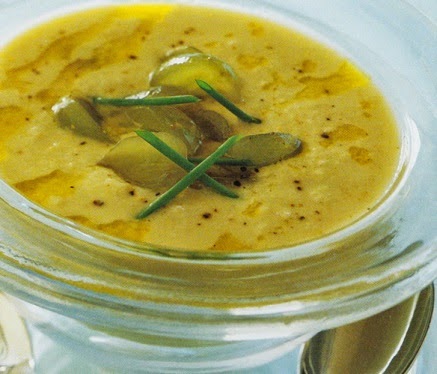
Chilled Almond Soup with Grapes


Called ajo blanco – white garlic soup – this is a Moorish recipe of ancient origin. It is a perfect balance of crushed almonds, garlic and vinegar in a smooth purée enriched with olive oil.

Although today we use a food processor or blender to break down the bread, almonds and garlic, in days of old this grinding would have been done with a pestle and mortar.

To accentuate the flavour of the almonds, dry roast them in a frying pan until they are lightly browned before grinding them. This will provide a slightly darker soup.

Ingredients:
115g stale white bread
250ml blanched almonds
2 garlic cloves, sliced
75ml olive oil
25ml sherry vinegar
Sea salt and freshly ground black pepper

For the Garnish:
Toasted flaked almonds
Green and black grapes, halved and seeded
Fresh chives, chopped

Method:
Break the bread into a bowl and pour 150ml cold water over it. Leave to soak for about 5 minutes, and squeeze the bread dry.

Put the almonds and garlic in a blender and process until very finely ground. Add the soaked white bread and process again until thoroughly combined. Continue to process, gradually adding oil until the mixture forms a smooth paste. Add the sherry vinegar, followed by 600ml cold water and process until the mixture is smooth.

Transfer the soup to a large bowl and season with salt and pepper, adding a little more water if the soup is very thick. Cover with cling film and chill for 2 hours or more.

Ladle the soup into bowls. Scatter the almonds, halved grapes and chopped chives over to garnish.


Serves 6

Monday, 24 February 2014

Spanish Chicken with Sherry and Peppers

Spanish Chicken with Sherry and Peppers

Ingredients:
4 skinless chicken breasts
30 ml olive oil
Salt and freshly ground black pepper
3 cloves garlic, peeled and sliced
150ml dry sherry
150ml chicken stock
290g jar roasted red peppers, drained and sliced
15g toasted flaked almonds

Method:
Heat the oil in a non-stick frying pan. Lightly season the chicken breasts and brown in the oil for 2 minutes each side over a high heat.

Add the garlic and cook for 1 minute, then add the sherry, stock and red peppers. Bring to a fast simmer, cover and cook for a further 5 minutes until the sauce has reduced and is slightly syrupy.


Serve with the toasted almonds scattered over the chicken.

Monday, 18 November 2013

Moroccan Chicken Tagine


A Tagine is a unique type of ceramic or clay cookware that's popular in North Africa, especially Morocco. The bottom is a wide, circular shallow dish used for both cooking and serving, while the top of the tagine is distinctively shaped into a rounded dome or cone. The cone lid is made at a particular angle to allow condensed steam from the liquid used in cooking to flow back into the pot. Tagines are still favoured by those who appreciate the unique, slow-cooked flavour which the earthenware imparts to the food. Cooking in a tagine is different than cooking in a conventional pot in a number of ways. Firstly, the earthenware pot doubles as both a cooking vessel and serving dish which holds the food warm. Since you won't be stirring during the cooking, take care how you arrange or layer ingredients for a beautiful table presentation. A ceramic or clay tagine should only be used over low to medium-low heat to avoid damaging the tagine or scorching the food; use only as much heat as necessary for maintaining a simmer. When cooking on an electric or gas heat source, a diffuser is essential so that the heat of cooking does not get too high. Tagines may also be cooked over small fires or in braziers over charcoal. Be aware that it can be tricky to maintain an adequately low temperature with these methods. It's best to use a small quantity of charcoal or wood to establish a heat source, and then periodically feed small handfuls of new fuel to keep the fire or embers burning. This way you'll avoid too high a heat. You can use a clay or ceramic tagine in an oven; place the cold tagine in a cold oven on a rack, then set the thermostat to no more than 160° C -180° C. Patience is required; let the tagine reach a simmer slowly and know that poultry takes about two hours to cook while beef or lamb may take up to four hours. Try not to interrupt the cooking by frequently lifting the lid to check on the food; that's best left for adding ingredients or to check on the level of liquids toward the end of cooking. 

The stew or curry cooked in it is also called a "Tagine."
The making of this curry can also be made in a regular style stewing pot.

Ingredients:
50ml olive oil
3 cloves of garlic, chopped
1 onion, finely chopped
5ml ground ginger
5ml ground cumin
5ml ground turmeric
2.5ml ground cinnamon
30ml tomato paste
375ml chicken stock
Freshly squeezed juice of 1 orange
100g mixed dried fruit, such as raisins, apricots and sultanas, chopped
Sea salt and freshly ground black pepper to taste
750g boneless chicken thighs, cut up
60ml slithered almonds

Method:

Heat the oil to a medium in a large deep pan. Add the garlic and onion. Sauté briefly until aromatic, about a minute or less. Do not let the garlic brown. Immediately adjust the heat to the lowest setting. Add all the spices and cook gently for about 4-5 mins or until the onion softens. Pour the orange juice and the dried mixed fruits. Season with salt and pepper and stir.

Stir in the tomato paste and the chicken stock. Add the chicken and coat with the sauce. Bring to a boil. It may look quite thick at this point, but don't worry it will produce some more liquid as the chicken cooks.

Cover and simmer for about an hour or until the chicken is fully cooked and tender. You may add a little water as you cook it if you find that the sauce is too thick for your liking. Adjust seasoning if necessary. Sprinkle the sliced almonds for garnish. 


Serve hot with rice and plain yoghurt on the side, if desired. 


This curry, like all spiced dishes, is even better the next day!

Enjoy your Moroccan chicken curry!


Thursday, 26 September 2013

Scandinavian Almond Bars

Ingredients:
210g cups cake flour*
10ml baking powder
1ml salt
250ml sugar
125g butter, room temperature
1 egg, room temperature
2.5ml almond extract

* For a Gluten Free version of this recipe, simply replace flour with:

250ml brown rice flour *
125ml tapioca starch *
60ml potato starch *
180ml oat flour *
2.5ml xantham gum *
The Gluten Free version required a full 20-22 minutes to finish baking.

Topping:
15ml milk
125ml sliced almonds

Icing:
250ml powdered sugar
1ml almond extract
15-30ml milk

Method:

Preheat the oven to 170˚C. Whisk together the flour, baking powder and salt and set aside. Cream together the butter and the sugar. Add the egg and the almond extract and then mix until light and fluffy. Slowly add the flour mixture to the butter mixture. Mix until combined. 
Press the dough into the bottom of a thoroughly buttered 9x13 inch pan. Press with your fingers or a pastry roller to smooth the top of the dough. The gluten free dough is a bit stickier than the traditional version. I found that it was easiest to place a sheet of parchment or wax paper on top of the dough and press it into the pan with my hands that way.

Using a pastry brush, brush a tiny bit of milk across the top of the dough. Sprinkle with sliced almonds and very lightly press them into the top of the dough. Bake for 16-20 minutes. Remove from the oven when they are just barely beginning to brown and they look dry around the edges. Do not let them actually brown at all. If they brown, they will be much more crunchy than desired, once they cool. The goal is a very soft shortbread texture.

Let the bars cool in the pan for 5 minutes and then cut into bars. If they are too soft to cut, let them cool for a few more minutes. Remove them carefully (they will be quite soft) to a wire rack to cool completely before icing. Prepare the icing, adding just a tiny bit of milk at a time. If the consistency is too thick, it won't drizzle nicely over the bars. If it is too thin, the icing will just melt into the bars. If you are unsure, test a bit of it on the edge of one bar before drizzling the icing over the entire batch.


Leave the bars on the wire rack until the icing is firm enough to handle. These bars store quite well in the freezer. I can usually fit 2 dozen in a gallon size ziploc bag, with a sheet of wax paper separating the layers. When you are ready to eat them, just set them on the counter about half an hour before hand. I typically plate them while they are still frozen, because they are easy to handle that way. Enjoy!

Monday, 7 November 2011

Green Beans With Parmesan, Garlic Butter and Almonds

Ingredients:
400g fresh whole green beans
30g butter
1 clove garlic
15ml grated parmesan cheese
60ml slithered almonds

Directions:
Top and tail the beans and cook them for 2-3 minutes in salted boiling water. Lift them out of the water with a slotted spoons and drain on kitchen paper.
Meanwhile, melt butter in a small saucepan over medium-low heat. Add the garlic and sauté for 2-3 minutes until the garlic is tender, but not coloured, stirring frequently. Add the almonds and continue to cook for 1-2 minutes.
Add the cooked green beans to the garlic butter and stir to heat through, coating the beans with the butter and nuts. Transfer to a serving dish and sprinkle with parmesan cheese.

Tuesday, 19 July 2011

Lite Coronation Chicken Salad

For those of you who are conscientious about eating healthy, here is a variation on the classic British dish, Coronation Chicken, without the masses of mayonnaise. It's even more delicious than the original and far better for you all round. With crunch and sumptuous flavours of the orient and the juicy peppery taste of watercress, it's ever so quick and easy and you are going to love this as much as I do.

If you can't get mango chutney you could make mine - find the recipe HERE, or use fresh mango slices and a chutney of your choice, something like Apricot Chutney or Autumn Chutney.

Ingredients: - Serves 2
2 skinless chicken breasts
5ml mild curry powder
50ml olive oil
30ml mango chutney
zest and juice of half a lemon
half a cucumber, peeled, seeds removed and cut into 2 inch sticks
2 handfuls of watercress
toasted almond flakes to garnish

Method:
Toss the chicken breasts with 10-15ml olive oil and the curry powder to coat evenly, then leave to marinate for 10-15 minutes.

Meanwhile, prepare the salad: Reserving 10-15ml olive oil to cook the chicken, mix the remaining oil with the chutney, lemon zest and juice. Put the cucumber sticks and watercress in a salad bowl and dress with the chutney mixture, tossing to distribute the dressing.

Heat a frying pan with the reserved oil and cook the chicken for 5-6 minutes, turning over halfway through the cooking. When done the chicken should be just cooked through but still succulent. Cut the chicken breasts into 1/2 cm slices and allow to cool slightly before tossing through the salad.

Serve, garnished with toasted almond flakes.

Monday, 23 May 2011

Orange Raisin and Almond Rice

It doesn't take much to dickey up a bit of rice, but what a difference it makes when it's pleasing to the eye and not just a plain bed of white. An orange, a couple of onions, a few hard boiled eggs and a sprinkling of nuts and raisins and you have something quite amazing!


Ingredients:

60ml ghee
2 large onions sliced in rings
seeds from 2 cardamom pods
2 sticks cinnamon
4 cloves
500ml long grain rice or basmati rice
250ml fresh orange juice
freshly shredded zest from 1 orange
1 litre of chicken stock
125ml blanched and sliced almonds
60ml raisins
3 eggs, hard boiled and sliced

Method:


Heat the ghee and fry the onion rings until they are a pale golden brown. Drain and set aside. In the same ghee, fry the almonds and raisins. Drain and set aside. Add the cardamom seeds, cinnamon and cloves to the pan and fry for about 1 minute then remove from the heat and stir in the dry rice, orange juice, half of the orange rind and the chicken stock.


Return to the stove and bring to the boil, lower the heat, cover and simmer until all the liquid has been absorbed - about 25 minutes. Toss in the fried onion rings, almonds and raisins and garnish with the sliced hard boiled eggs and the remaining orange zest.


Monday, 16 May 2011

Favourite Indian Sweets

There are a great variety of Indian sweets and desserts, the wide range ensured by the profuse use of rice, vermicelli, ground wheat, milk and a host of other ingredients. Traditionally Indiand serve a sweet at the beginning of a meal as a gesture of goodwill, although today in many South African Indian homes, this custom is falling away. In keeping with the western influence, the sweet dish may be served at the end of the meal as the hostess endeavours to lull the most voracious of appetites into quiet appreciation and to placate those with a sweet tooth. There are many western sweet dishes that are great favourites on Indian tables. Halwas and lagans may be called the equivalent of western puddings and mithais may be compared to fudge, although strictly there can be no comparison as they are quite different, and who could ever forget Burfee once they have tasted it?

My first introduction to Indian sweets came the year I started work and our Indian staff members brought Diwali cakes to share at work. Having an unbelievable sweet tooth, I could have eaten the lot in one go. I loved them! My plan is to share some of them here, the easier to make ones that is as some are very complicated to make. My absolute favourite has to be Gulaab Jamun, or Indian Doughnuts.

Galaab Jamun - Indian Doughnuts

Ingredients:
For the doughnuts:
325ml flour
3ml bicarbonate of soda
10ml baking powder
30ml semolina
3ml finely ground cardamom powder
30ml ghee
1 tin condensed milk
Ghee or vegetable oil for deep frying

For the syrup:
250ml water
375ml sugar
5ml rose water

Method:
Put the dry ingredients and the cardamom powder in a bowl. Rub in the ghee then blend in the condensed milk to make a soft dough. Roll the dough into a thick sausage and cut off 1 cm pieces. Roll each piece into a sausage the length and thickness of a forefinger. These can also be made as round balls if you prefer.

Deep-fry these in batches over medium heat. The fat should not be too hot or the doughnuts will not swell. Remove from the fryer with a slotted spoon when golden brown and drain on kitchen paper. Meanwhile, prepare the syrup.

Boil together the water, sugar and rose water until the sugar has dissolved and the syrup is beginning to thicken. Reduce the heat to very low so as to just keep warm.

Once the doughnut balls have drained off any residual oil, plunge them into the syrup for about 30 seconds. Remove from the syrup with a clean slotted spoon and drain on a wire rack. Allow them to cool before serving.

Marie Biscuit Date Delights
Marie Biscuits are one of the favourite biscuits in South Africa,
the UK equvalent of which would be Sweet Tea Biscuits.
Ingredients:
2 packets of Marie Biscuits, crushed in chunks, not crumbled
250g butter
250ml sugar
750g pitted dates, chopped
1 egg, beaten
30ml coconut

Method:
Place the butter and sugar in a pot and melt together. Add the chopped dates and simmer gently until the mixture is soft and well blended. Allow to cool slightly before adding the egg. Add the beaten egg, blending into the mixture quickly so the egg does not scramble. Finally add the crushed biscuits.

Spread the mixture on greased baking trays, flattening smoothly. Sprinkle the top with desicated coconut. Leave in the fridge for about an hour to set. Cut into slices or squares.


Larwa - Almond Balls
Ingredients:
For the syrup:
500g suagr
250ml water
For the Lawa Balls:
500ml chana flour
7.5ml baking powder
10ml solid ghee
250ml water
10ml egg yellow colouring
slivered almonds
Method:
To make the Syrup:
Put the sugar in a pan with the water and heat to disolve. Simmer until the syrup becomes sticky, but does not form threads. Remove it to the side of the stove so that it keeps warm.
To make the Lawa Balls:
Mix together the chana flour and baking powder and rub in the ghee. Add the water and mix to form a thick batter. Press this through a meat mincing machine on a small setting and transfer the 'worms' to a pan of hot oil to fry until golden. Transfer the bhoondis, or worm shaped fried larwa bits, to the hot syrup and steep them until all the syrup is absorbed. Cool and set aside for a couple of hours, then mould the resulting dough into balls about the size of golf balls. Roll these balls in the slivered almonds.

Burfee - Indian Fudge
As you will find, if you attempt this delicacy, I've left the best till last. Burfee is the closest to fudge you can get in Indian sweets. It's creamy and almost sickeningly sweet, but is a firm favourite with those who enjoy sweetmeats. Although it is quite a difficult thing to make, I believe all good things are worth taking the trouble over!
Ingredients:
For the Mawa:
3 litres milk
For the Burfee:
500g mawa
40ml double cream
30ml ground almonds
250g full-fat milk powder
500ml water
360g sugar
2.5ml fine ground cardamom powder
15ml rose water
icing sugar for dusting
Method:
To make the Mawa:
Using 500ml at a time, boil the milk rapidly over high heat, stirring all the time to make sure it does not catch on the bottom of the pan, until a hard lump remains. Remove this hard lump and set aside. Continue with the rest of the milk until you have 500g of mawa.
To make the Burfee:
The mawa will be hard and lumpy so cut it up into pieces and put it into a mixing bowl. Add the cream, almonds and milk powder and blend well. Leave aside for a few hours to dry. Put in a fodd processor and blitz, then set aside again for an hour or two.
In a saucepan, make a syrup with the water and sugar, stirring till all the grains of sugar are disolved in the water. Bring the syrup to the boil, then lower the heat and continue to simmer until the syrup is reduced by about a third in volume and is thickened, but not sticky. Add cardamom and rose water.
Add the cream and milk mixture to the syrup over low heat and stir till the syrup is absorbed into the cream and milk mixture. Remove from the heat and transfer to a mixing bowl. Leave for a couple of hours before patting it into ice cube size blocks. Dust with icing sugar and leave to dry.


Sunday, 26 December 2010

Cranberry and Almond Pudding

By now, you may have registered that I rather enjoy cranberries.
In fact I regularly consume these wonderful health-giving fruits,
whether in juice, or sauce,
or the fruit themselves in pies or puddings.
Cranberries contain a high level of oligomeric proanthocyanidins,
Which are powerful antioxidants with anti-inflammatory,
anti-carcinogenic and antimicrobial properties.
Here's a few of the health benefits:
.
Urinary tract infections:
The acidic nature of the fruit changes the PH of urine, thus preventing bacteria form adhering to the bladder walls where they multiply, causing infection.
.
Stomach ulcers and cancer:
This fruit's acidity has the ability to destroy Helicobacter pulori bacteria, which have been found to cause stomach ulcers, and in severe infections, lead to stomach cancer.
.
Respiratory infections:
Cranberry helps fight strains of Haemophilus Influenzae bacteria found in the nose and throat of many healthy people, which is responsible for causing many throat and ear infections.
.
Cardiovascular disease:
The polyphenols present in cranberry appear to increase the levels of good cholesterol (HDL) and decrease the levels of Bad cholesterol (LDL) in the blood, thus reducing the risk of cardiovascular disease.
.
Oral health:
Cranberry juice is effective in reducing harmful bacteria in the mouth.
.
Other benefits:
Prevention of kidney stones
Slows the aging process
Aid in weight loss by emulsifying fat deposits in the body
These fruit are a good source of calcium
..
.
Cranberry and Almond Pudding
.
Ingredients:
250g frozen cranberries
50g butter
50ml sugar
125g melted butter
2 eggs
zest of 1 orange
175g self raising flour
175g sugar
2.5ml baking powder
50-60g flaked almonds
30-40ml demerara sugar
.
Method:
Preheat the oven to 160C.
Put the cranberries, 50g butter and 50ml sugar in a pan and cook gently until the fruit begin to pop and ooze their juices.
In a bowl, add the eggs and orange zest to the melted butter and whip together. (wet ingredients)
In a second bowl, mix the flour, sugar and baking powder. (dry ingredients)
Add the wet ingredients to the dry ingredients to make a batter.
Grease a pie pan or a spring form round cake tin. Put half the batter mixture on the bottom of the pie pan. Pour the cranberries over this and top with the second half of the batter mixture. Sprinkle with flaked almonds and demerara sugar.
Bake in a relatively low oven, about 160C, for about 60 minutes.
Serve hot with whipped cream, custard or ice cream.
.